A remote staffing company is not just a recruiter; it is an operational partner that helps businesses hire, integrate, and manage professionals who work from different locations, often across borders, while functioning as a seamless extension of the internal team.
Instead of relying on local hiring, businesses gain access to a global talent pool without taking on the operational burden of sourcing, vetting, onboarding, compliance, and ongoing workforce management. A strong remote staffing agency goes beyond filling roles—it builds alignment between the business need and the human capability behind it.
This distinction matters.
Because hiring today is no longer just about finding someone who can do the job, it is about finding someone who fits the role, the pace, the communication style, and the growth trajectory of the company.
The Hiring Reality Small and Mid-Sized Businesses Face
Hiring has always been a challenge. Today, it has become a bottleneck.
Businesses across industries are experiencing a growing gap between the demand for skilled professionals and the ability to hire them efficiently.
Larger organizations have the advantage of brand visibility, internal recruitment teams, and the ability to absorb long hiring cycles.
But for small to mid-sized businesses, this challenge is real. And immediate.
A report from the National Federation of Independent Business shows that over 40% of small businesses struggle to fill open roles.
What is a temporary inconvenience for a large enterprise becomes a daily operational strain for smaller teams. And that’s where the gap is widening.
The average time to hire in the U.S. is around 36–44 days (Society for Human Resource Management, SHRM)
What A 36–44 Day Hiring Delay Really Costs
Average Days To Fill A Position
Projects Move Slower
Lost Revenue Opportunities
Internal Team Burnout
On paper… that’s just over a month. For a large company, it’s part of the process. For a small business, that’s 36–44 days of lost momentum.
On paper, that may seem manageable.
In reality, for a growing business, that delay translates into:
- Founders pulled into daily operations instead of strategic growth
- Slower response times to customers and missed opportunities
- Internal teams stretched beyond capacity
- Projects delayed or left incomplete
- Revenue that could have been captured—but wasn’t
For small businesses, hiring delays are not administrative—they are directly tied to lost momentum.
Why Traditional Hiring Models Are Breaking Down
Companies that rely exclusively on local recruitment are facing structural limitations:
- Long hiring cycles
- Skill shortages
- Rising recruitment costs
- Competition for top candidates
For large companies, this is a challenge. For small businesses, it becomes a constraint.
What the data is really telling
40% of the global workforce now works remotely at least part-time.
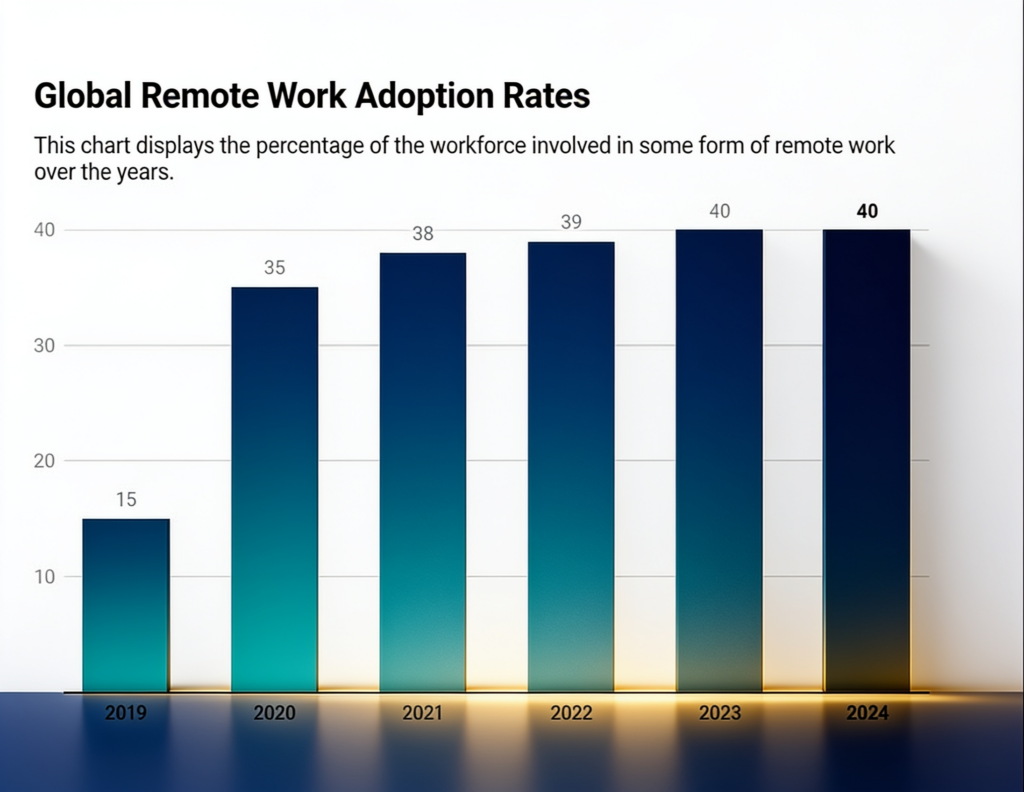
Image Source: hrstacks.com
Nearly 77% of remote workers say they are more productive offsite.

Image Source:worktime.com
This means one simple thing: Talent is no longer tied to location.
When you open your hiring beyond your city, everything changes: you reduce hiring time, address the skills shortage, control costs without compromising quality, and compete with larger companies.
This shift is why businesses increasingly rely on a remote staffing company to access qualified professionals faster and more efficiently.
The key question becomes:
How do remote staffing companies actually connect businesses with top talent so quickly?
The process is not random—it follows a highly optimized talent acquisition framework.
Understanding the Core Hiring Problem Businesses Face
Before understanding the solution, it is important to look closely at where hiring actually breaks down.
Most businesses don’t struggle because they lack intent or effort.
They struggle because the hiring system they rely on is no longer aligned with how talent behaves today.
What looks like a hiring delay on the surface is actually a combination of structural bottlenecks that compound over time—slowing growth, increasing costs, and creating operational pressure.
Talent Shortages Across Industries
One of the most visible challenges businesses face today is the inability to find specialized, role-ready professionals within their local market.
This is no longer limited to highly technical roles. Across industries—whether it’s software development, accounting, marketing, or operations—companies are encountering the same pattern:
- Fewer qualified candidates locally
- Higher competition for the same talent pool
- Increasing salary expectations driven by demand
But the deeper issue is not just a shortage; it is the misalignment between where talent exists and where companies are looking.
A remote workforce study highlights this shift clearly:
64% of recruiters say remote work flexibility is now a top priority for candidates when choosing jobs.
This means a significant portion of the workforce is actively prioritizing flexibility over traditional, location-bound roles.
In practical terms, this creates a disconnect:
- Companies hiring locally are limiting themselves geographically
- Candidates are thinking globally and prioritizing flexibility
The result?
Businesses are not competing for all available talent—they are competing for a shrinking subset of it.
Meanwhile, companies that embrace remote hiring expand their access instantly. Research also shows that organizations offering remote work options attract higher-quality, more diverse talent.
So the issue is not just a shortage—it is a constrained hiring lens.
Traditional Hiring Timelines Are Structurally Slow
Even when companies find potential candidates, the hiring process is inherently slow.
A typical traditional hiring workflow includes:
- Job postings across multiple platforms
- Screening large volumes of resumes
- Coordinating multiple interview rounds
- Internal alignment and decision-making
- Offer negotiation and acceptance
- Individually, each step makes sense.
Collectively, they create a time-intensive, sequential process that often takes 30–60 days or more.
But the real impact of this delay is rarely discussed in operational terms.
During this hiring window:
- Projects stall because critical roles remain unfilled
- Existing team members take on additional workload, reducing efficiency
- Customer response times slow down
- Strategic initiatives get postponed
In high-growth environments, this delay is not neutral—it compounds losses.
At the same time, candidate behavior has changed.
Top candidates do not stay available for long. They are evaluating multiple opportunities simultaneously and often accept offers quickly—especially when flexibility is involved.
This creates a mismatch:
Businesses move at hiring speed.
Candidates move at decision speed.
And that gap leads to missed hires—not because the company couldn’t find talent, but because it couldn’t move fast enough to secure it.
The Hidden Cost Layer in Traditional Hiring
Beyond time, traditional hiring also introduces layered and often underestimated costs.
Most businesses account for visible expenses like:
- Recruitment agency fees
- Job board postings
- HR and recruiter salaries
- Candidate sourcing tools
But the deeper cost structure is operational:
- Leadership Time Drain
Founders and senior managers spend hours in interviews and evaluations, time that should be invested in growth, strategy, or revenue generation.
- Productivity Loss
Every unfilled role reduces team output. Work gets delayed, quality drops, and internal efficiency declines.
- Opportunity Cost
Perhaps the most significant—but least measured—cost.
Missed deadlines, delayed launches, and unserved customers directly impact revenue.
- Re-hiring Risk
Without structured evaluation systems, traditional hiring increases the likelihood of mis-hires, leading to repeat hiring cycles and additional costs.
When you combine these factors, hiring is no longer just a recruitment expense.
It becomes an ongoing operational liability.
How Top Talent Is Delivered Faster
Talent Pipeline
Skills Screening
Role Matching
Fast Placement
How a Remote Staffing Company Speeds Up Talent Acquisition
A high-quality remote staffing agency does not simply execute the same process faster. It restructures the hiring model entirely.
Instead of starting from scratch every time, it operates on pre-built systems designed for speed, accuracy, and scalability.
Building Talent Pipelines Before Demand Exists
One of the most important differences is that remote staffing companies do not wait for hiring requests before beginning to source talent.
They continuously build and maintain talent networks across industries, including:
- Software development
- Digital marketing
- Finance and accounting
- Customer support
- HR and operations
- Data and analytics
This proactive approach means that when a business needs to hire, the candidates already exist within a vetted ecosystem.
Hiring does not start at zero—it starts with readiness.
Pre-Screening and Vetting Talent in Advance
Candidate evaluation is one of the most time-consuming aspects of hiring.
Remote staffing companies remove this bottleneck through structured, multi-layered screening processes—often supported by platforms like Ducknowl.
These systems quietly bring consistency and speed to something that is usually subjective.
These typically include:
Communication Assessment
Through structured video responses and scenario-based questions, candidates are evaluated on:
- clarity of thought
- ability to explain ideas
- responsiveness in real-world situations
For small businesses, this matters as much as technical skill.
Skills Validation
Candidates are assessed through practical tests, technical evaluations, and simulations of real-world tasks relevant to their roles.
AI-Supported Screening (Done Thoughtfully)
Platforms like Ducknowl use AI not to replace judgment but to strengthen it.
They help:
- Identify inconsistencies in responses
- flag overly scripted or AI-generated answers
- detect patterns that may indicate surface-level understanding
This reduces the risk of candidates who “sound good”
but struggle in real execution.
Background Verification
Professional history, certifications, and domain expertise are verified to ensure credibility.
Communication and Remote Readiness
Since remote work depends heavily on clarity and collaboration, candidates are evaluated on:
- Communication skills
- Time-zone alignment
- Familiarity with remote tools and workflows
The result is simple but powerful:
Businesses only interact with high-quality, role-ready candidates—not raw applicants.
Data-Driven Matching for Better Role Fit
Modern remote staffing agencies use structured data to match candidates with business needs.
Instead of relying on intuition alone, they evaluate:
- Skill alignment
- Industry experience
- Time-zone compatibility
- Budget expectations
- Project scope and timelines
This significantly improves the quality of hires.
Research from Stanford shows that remote workers can achieve a 13% increase in productivity when properly aligned with their roles and work environments.
- Better matching leads to:
- Faster onboarding
- Higher productivity
- Lower turnover
- Stronger long-term outcomes
Remote-Ready Infrastructure That Eliminates Delays
A key advantage of remote staffing solutions is that they already have operational infrastructure in place.
This includes:
- Project management systems
- Communication and collaboration tools
- Remote onboarding workflows
- Performance monitoring frameworks
- PAYMENT SET UP IN LATAM
Without this infrastructure, businesses often lose weeks setting up remote employees.
With it, teams can start contributing almost immediately.
Additionally, remote professionals benefit from fewer daily disruptions. Studies show that remote workers save 40–72 minutes per day previously spent commuting—time that is often reinvested into productive work.
Cross-Industry Talent Availability
A strong remote staffing company is not limited to a single domain.Because they maintain diverse talent pipelines, they can quickly support roles across:
Technology
- developers
- QA engineers
- DevOps specialists
Finance
- bookkeepers
- financial analysts
- tax specialists
Marketing
- SEO specialists
- content strategists
- performance marketers
Operations
- virtual assistants
- support agents
- operations managers
This breadth allows businesses to scale across multiple functions without restarting the hiring process each time.
Moving Beyond “Cheap Talent”: The Shift to Strategic Hiring
Many businesses initially approach remote hiring with a cost-first mindset.
Lower salaries. Faster hiring. Immediate relief.
But that approach often leads to inconsistent results.
The real value of a remote staffing agency lies not in cost reduction—but in structured, guided hiring.
This is where Simpalm Staffing distinguishes itself.
The Competitive Advantage
Expand hiring beyond local limitations.
Reduce recruitment delays significantly.
Structured matching improves retention.
Grow teams without increasing hiring complexity.
The Simpalm Staffing Approach: Guided Hiring, Not Just Candidate Delivery
Simpalm Staffing does not operate as a transactional recruiter. It functions more like a Sherpa for hiring decisions—guiding businesses through the complexity of building remote teams effectively.
Focus on LATAM Talent for Real-Time Collaboration
Instead of offering global talent without structure, Simpalm Staffing focuses on LATAM professionals who align closely with U.S. time zones.
This enables:
- Real-time communication
- Faster decision-making
- Better integration with internal teams
Structured Hiring System Focused on Role Fit
Rather than simply presenting candidates, Simpalm follows a structured evaluation process that prioritizes:
- Role-specific capability
- Communication alignment
- Long-term fit
This reduces the risk of mismatched hires—a common issue in remote staffing.
Proprietary Screening Platform: Ducknowl
Simpalm has developed its own screening platform, Ducknowl, which is also used by recruitment agencies across the U.S., UK, and India.
This is a critical differentiator.
It demonstrates that the hiring system is:
- Tested across markets
- Based on real hiring data
- Designed for consistency and scalability
This is not subjective screening—it is a repeatable, proven framework.
Ongoing Support Beyond Hiring
Hiring is only the first step. Performance and retention are where real value is created.
Simpalm staffing provides ongoing support to ensure:
- Smooth onboarding
- Clear communication structures
- Continuous performance alignment
This transforms remote hiring from a one-time event into a sustainable operational strategy.
Conclusion: Remote Staffing as a Competitive Advantage
The workforce has changed—and hiring models must evolve with it.
Businesses that rely solely on traditional hiring approaches often remain constrained by:
- Slow recruitment cycles
- Limited talent pools
- Increasing costs
Large companies can absorb these inefficiencies.
Smaller and growing businesses cannot.
A remote staffing company bridges this gap by offering:
- Access to global, high-quality talent
- Faster and more efficient hiring processes
- Reduced operational burden
- Scalable team-building capabilities
But the real advantage is not just speed or cost.
It is the ability to hire strategically—with the right people, in the right roles, at the right time.
In a world where execution speed defines success, the companies that win are not the ones with the most resources.
They are the ones who can access and deploy talent—faster, smarter, and without limitations.
Read More: What Is Remote Staffing: A Complete Guide
Ready to Build Your Remote Dream Team?
Simpalm Staffing matches US companies with top LATAM professionals.
Book a Free Discovery Call →