
There is a stage in business growth that most founders never anticipate.
At first, the financial side feels simple. Revenue comes in, expenses go out, and the owner usually has a strong instinctive sense of where the company stands.
Then growth happens.
New customers are coming in faster. More vendors need to be paid. Recurring software costs increase. Team payroll becomes layered. Client invoicing expands across multiple accounts. Refunds, discounts, and vendor credits begin stacking up.
From the outside, this looks like success.
But behind the scenes, something far more dangerous begins to happen: financial visibility starts breaking down.
This is the point where many leaders open their reports and ask the question they never expected to ask:
Are we actually profitable?
SCALING CHALLENGES
Why Bookkeeping Gets Harder As You Grow
More Transactions
Growing customer activity creates significantly more financial records to manage.
Payment Channels
Credit cards, ACH, Stripe, PayPal, and multiple bank accounts increase complexity.
Invoice Volume
Higher client activity means more invoices, collections, and reconciliations.
Vendor Management
Additional suppliers create more expense categories and approval workflows.
Payroll Growth
Employees, contractors, and benefits add new reporting requirements.
Tax Compliance
More transactions create greater tax reporting and documentation obligations.
The problem is rarely a lack of revenue.
The problem is that financial complexity grows faster than internal systems can keep pace.
As operations scale, bookkeeping naturally becomes harder:
- more transactions flowing through multiple channels
- Higher invoice volume
- more vendor and expense categories
- payroll and contractor reconciliation
- growing reporting obligations
- tax-sensitive documentation
- accounts receivable aging issues
Without structured bookkeeping systems, the leadership team loses the ability to understand the numbers that matter most quickly.
And when that clarity disappears, decisions slow down.
Hiring plans get delayed. Expansion becomes risky. Marketing budgets become guesses. Cash reserves become uncertain, which is exactly why growing companies begin turning to online bookkeepers, not simply for task support, but for financial structure that restores decision confidence.
The Hidden Cost of Doing Your Own Bookkeeping
Many business owners keep doing their own books for too long. They do this not because it’s the best way to use their time, but because handling small bookkeeping tasks feels easy enough.
A few hours every week spent fixing transactions, reconciling bank accounts, following up on invoices, or categorizing expenses is a reasonable trade-off.
The problem is that these tasks rarely stay small.
But over time, these small bookkeeping tasks silently compound into a major operational burden.
Research indicates that small business owners spend around 15 hours each month managing bookkeeping activities, including transaction recording, invoicing, and expense categorization.
That is time taken away from work that drives enterprise value:
- revenue generation
- sales leadership
- hiring and team development
- operational improvements
- strategic partnerships
- client retention
- long-term growth planning
- But the hidden cost is even bigger than time.
It is mental bandwidth.
When founders are personally managing bookkeeping, they remain trapped in low-leverage financial administration.
Instead of asking strategic questions like:
- Which service line has the strongest margin?
- What’s our burn-to-revenue ratio?
- Where is cash getting trapped?
- Which clients are slowing cash conversion?
They are busy fixing duplicates in QuickBooks.
This is where the real value of hiring a bookkeeper online begins to show: the benefit is not just saved hours, but the return of leadership focus to high-value business decisions.
THE COST OF FINANCIAL BLIND SPOTS
82%
of business failures are linked to cash flow problems
15 HRS
average monthly bookkeeping time spent by business owners
100%
required financial visibility for confident growth decisions
What Happens When Financial Systems Break Down
When bookkeeping remains inconsistent, manual, or reactive, the consequences spread far beyond the finance function.
The first symptom is usually unclear cash flow.
Revenue may look healthy on the dashboard, yet cash feels tight every month.
Bills are delayed. Vendor payments pile up. Payroll timing becomes stressful. Tax estimates feel uncertain.
This disconnect happens because many businesses are operating from a bank balance rather than financial reality.
Without consistent bookkeeping systems, companies often experience:
- delayed financial statements
- categorization mistakes
- inaccurate profit reporting
- missing or overdue invoices
- Vendor reconciliation issues
- weak forecasting visibility
- tax-season stress
- audit exposure
This is not just an accounting inconvenience.
It is a business risk.
Studies show that 82% of business failures are linked to cash flow issues.
That means the absence of structured bookkeeping is not merely an administrative gap.
It directly affects survival.
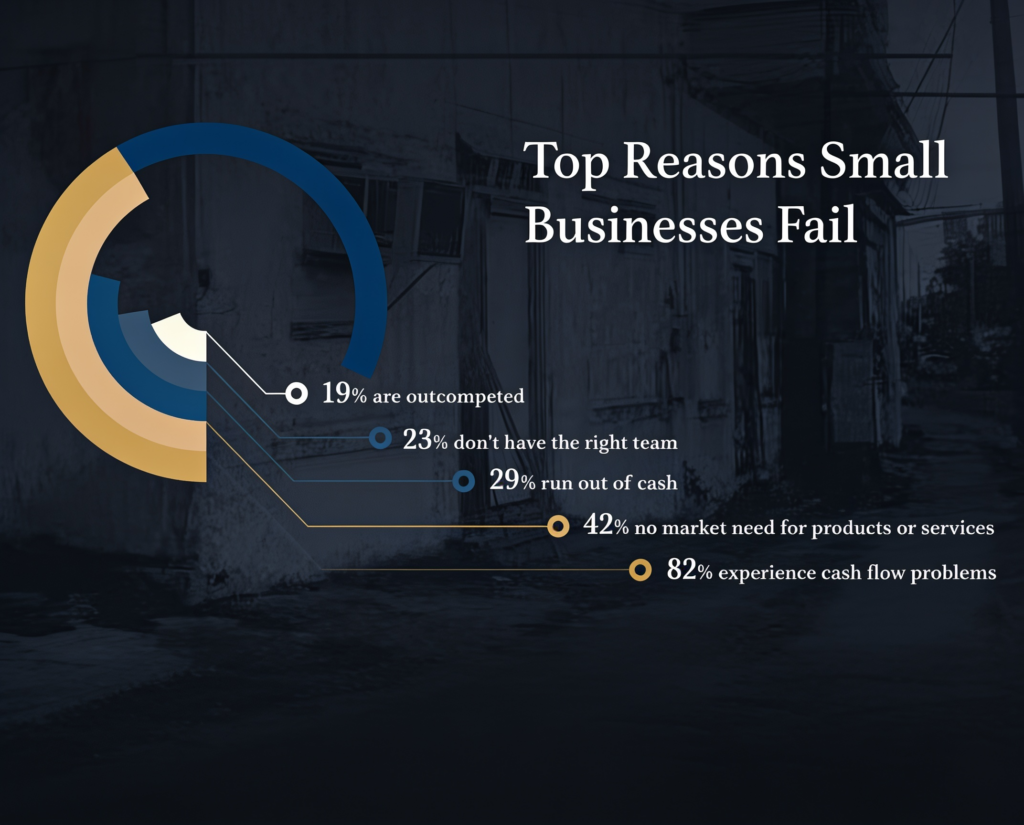
As financial complexity increases, many companies start exploring remote bookkeepers services because they realize the problem is no longer data entry.
The problem is operational blind spots.
What Actually Changes When Books Are Done Right
This is where most blogs oversimplify the conversation.
They talk about “saving time.”
That matters.
Because 83% of small business owners feel stressed by their workload and do not have enough time to do everything they need to do.
But time savings are not the real transformation.
The real shift is this:
Business owners stop guessing.
Once professional bookkeeping systems are in place, leaders can run the company on facts rather than assumptions.
Margins become visible.
- Cash timing becomes predictable.
- Revenue quality becomes measurable.
- Hiring decisions become safer.
- Growth stops feeling chaotic.
This is what professional online bookkeepers actually change.
What Changes with Professional Online Bookkeeping
Hiring an online bookkeeper doesn’t just “save time.”
It creates a structure.
Clear Financial Visibility
The most immediate improvement is clear financial visibility. Once a professional bookkeeping process is in place, the business gains access to accurate and timely reporting that leadership can actually trust.
Instead of waiting until the end of the month to understand performance, decision-makers can review real-time profit trends, expense movements, liabilities, and receivables. This clarity makes it easier to evaluate pricing, hiring, expansion, and vendor decisions without hesitation.
This means faster answers to critical questions:
- Which service lines are profitable?
- Where are margins slipping?
- Which clients create cash delays?
- Are fixed costs growing too quickly?
With reliable numbers, decisions move faster and with less risk.
Better Cash Flow Management
Cash flow improves almost immediately when bookkeeping becomes systematic.
Why?
Cash flow management also improves quickly. Consistent invoice monitoring, accurate categorization, and timely reconciliations create a far more predictable view of inflows and obligations. Rather than reacting to whatever appears in the bank balance, the business begins planning around known payment cycles, expected receivables, and future liabilities. This predictability is often one of the first operational relief points founders notice.
Instead of reacting to “whatever is in the bank,” the business begins planning for future obligations and expected inflows.
This is often the first major relief founders feel after hiring an online bookkeeper.
WHAT CHANGES WITH PROFESSIONAL BOOKKEEPING
The stress of uncertainty gets replaced by forward visibility.
More Time for Strategic Work
This is where ROI becomes visible beyond finance.
When founders no longer spend evenings reconciling statements or cleaning expense categories, leadership time shifts toward:
- growth planning
- team building
- client acquisition
- partnerships
- pricing strategy
- operational process design
This is where outsourced bookkeeping becomes a growth enabler, not just a support function.
The time recovered is not “free time.”
It becomes higher-value executive time.
Organized and Audit-Ready Records
Professional bookkeeping also introduces discipline into the company’s financial documentation.
This includes:
- clean reconciliation history
- supporting receipt documentation
- tax-ready categorization
- payroll consistency
- journal entry accuracy
- documented corrections
- month-end close workflows
The immediate result is fewer downstream errors and dramatically easier collaboration with CPAs, tax preparers, and lenders.
For growing companies, this becomes especially important when preparing for:
- fundraising
- loan applications
- due diligence
- tax filing
- compliance reviews
But Let’s Be Honest
Professional bookkeeping support is not an overnight fix, and sophisticated businesses understand that.
There is usually a transition period where systems need cleanup, historical records require correction, and workflows must be aligned with how the company actually operates.
In some cases, previous books may be disorganized enough that the first phase of the engagement is more about restoring order than maintaining routine reporting.
This is also where many businesses have disappointing outsourcing experiences.
The issue is rarely bookkeeping itself. The issue is the wrong delivery model.
A transactional freelancer may complete tasks, but without ownership, a clear communication rhythm, and alignment with the company’s operating hours, the work often remains disconnected from real decision-making. Reports get completed, but the business still lacks confidence.
That gap between “tasks completed” and “financial clarity achieved” is where provider quality matters most.
How Remote Bookkeeping Services Like Simpalm Staffing Support Businesses
Trust is not built into a contract. It’s built into how things work day to day. This is where Simpalm Staffing’s positioning becomes a genuine differentiator.
Businesses looking for a remote bookkeeping company rarely need low-cost labor. They need dependable financial process ownership from someone who can work as an extension of the business.
Simpalm approaches this through a structured LATAM staffing model designed around role fit, communication alignment, and operational continuity. Instead of simply assigning available talent, the focus is on matching companies with bookkeepers who understand the required systems, overlap with U.S. business hours, and can integrate naturally into the company’s reporting workflows.
We stay close to the process. Not in a heavy way. But in a steady, supportive way. We often describe this as a Sherpa-style approach; Staying alongside you as things stabilize, not just placing someone and stepping away.
Hiring remotely always carries uncertainty. We acknowledge that.
That’s why we keep things simple:
- no upfront commitment
- a 30-day performance guarantee
- flexibility to adjust if something isn’t working
The goal is not simply task completion. It is helping businesses build a financial support structure that scales with growth.
Conclusion
As businesses grow, financial management often becomes one of the most overlooked operational bottlenecks.
Without structured systems, leaders may spend dozens of hours every quarter managing bookkeeping tasks while still lacking confidence in profitability, cash flow, and financial readiness.
Hiring online bookkeepers delivers immediate operational improvements that go far beyond administrative support.
The immediate benefits include:
- more executive time for strategic growth
- organized financial records
- real-time reporting visibility
- improved cash flow management
- easier tax preparation
- stronger audit readiness
- reduced operational stress
- better financial oversight
- scalable reporting systems
For growing companies, professional remote bookkeepers services transform bookkeeping from a reactive burden into a structured financial system that supports sustainable growth.
And when that support comes through a strategic partner like Simpalm Staffing, the result is not just cleaner books.
It is better business decisions, stronger operational control, and more confident growth.
Read More: How Online Bookkeepers Can Save Your Company’s Time and Money
Ready to Build Your Remote Dream Team?
Simpalm Staffing matches US companies with top LATAM professionals.
Book a Free Discovery Call →